PLIM CHARITY · ENGLISH EDITION
By Mr Peyman Bakhshayesh, MD, PhD, MBA
Originally published on Secular Democratic Iran · 2026-10-23. Reproduced with the author’s original wording preserved.
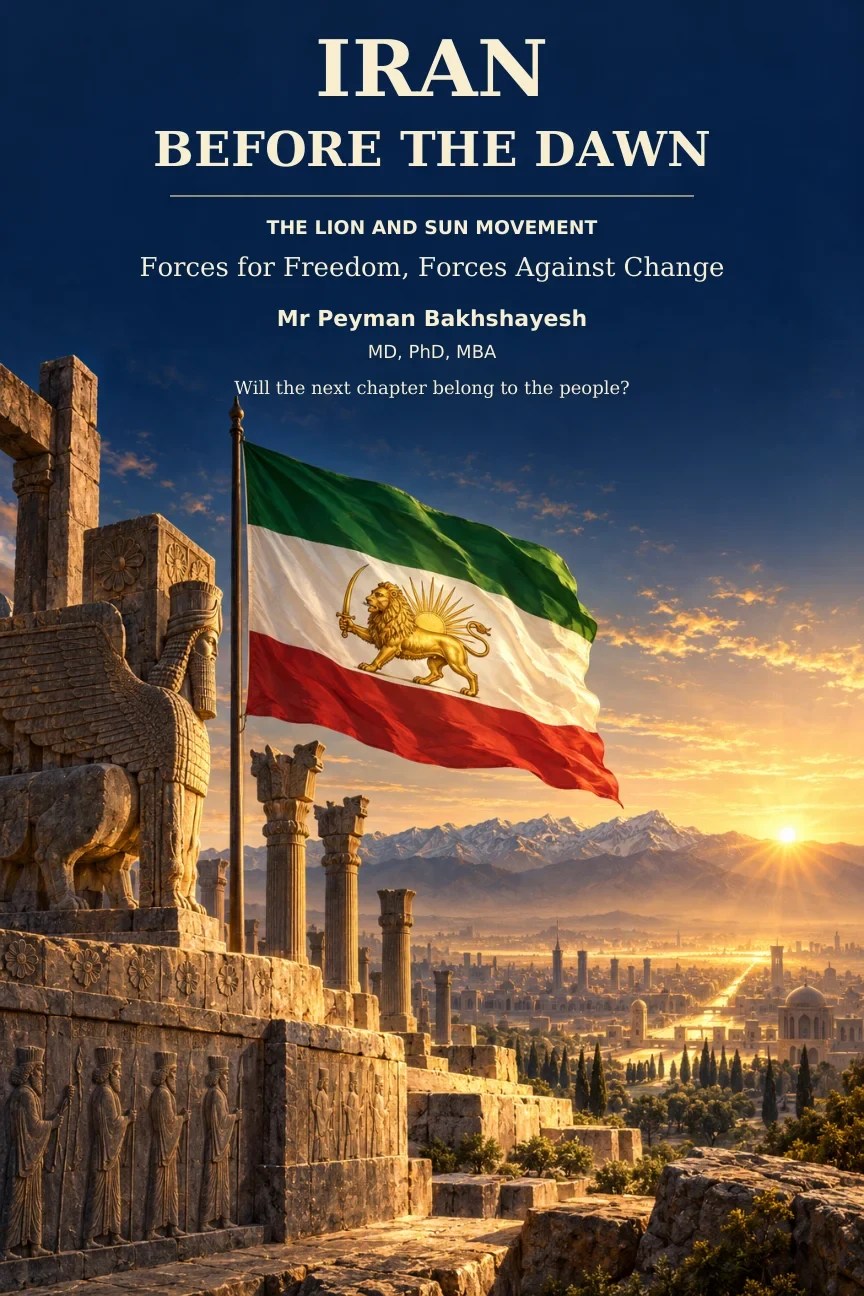
Iran Before the Dawn
The Lion and Sun Movement: Forces for Freedom, Forces Against Change
Mr Peyman Bakhshayesh, MD, PhD, MBA · 23 October 2026
Introduction: A surgeon, an Iranian, a constitutional monarchist
Preface: The question before the dawn
Chapter One: Iran: continuity, conquest and the unfinished constitutional journey
Chapter Two: The Pahlavi inheritance: a foundation for the future
Chapter Three: How the Islamic Republic emerged, consolidated and endured
Chapter Four: The Lion and Sun movement: promise, resilience and the work of unity
Chapter Five: Mapping the forces: PESTEL, SWOT and Lewin
Chapter Six: Beyond Iran: allies, obstacles and the independence of the national project
Introduction: A surgeon, an Iranian, a constitutional monarchist
My name is Mr Peyman Bakhshayesh, MD, PhD, MBA. I am a consultant trauma and orthopaedic surgeon, a teacher, a researcher and an Iranian who has lived through revolution, war, displacement and migration. My professional work concerns the reconstruction of damaged lives. My political writing concerns the institutions through which a damaged country can recover its capacity to live freely and build confidently.
I completed medical school in Shiraz in 1996. After military service as an emergency doctor at Be’sat Hospital in Tehran, I left Iran in 1998 and began a European journey that took me through Germany, Sweden and Britain. In Germany I pursued interests in politics, philosophy and economics alongside the practical demands of exile. My subsequent medical career developed through orthopaedic training, consultant practice, fellowships, major trauma work, research and clinical leadership. These autobiographical details follow my own accounts in My People and my earlier introductory writings. [1,11]
My political outlook has developed through experience. Earlier engagement with the Iranian left taught me to think about organisation, collective action and the relationship between a political idea and the people expected to carry it. Experience also taught me to reconsider inherited explanations. A political conviction should survive contact with evidence, with the consequences of its proposals and with the dignity of people who disagree. To change one’s mind after reflection is an exercise of responsibility.
I now identify clearly as a constitutional monarchist and a supporter of Crown Prince Reza Pahlavi. I believe that the Pahlavi inheritance offers Iran a powerful language of national continuity, state-building, education, development and constructive relations with the modern world. I support a future parliamentary monarchy because I believe that a constitutional crown can express national continuity while elected institutions govern. That is the constitutional arrangement I advocate; the Iranian people must have the freedom to choose it. [1–3]
I use Pahlavi Plus to describe the connection between that inheritance and the requirements of our century: secular democracy, equal citizenship, the rule of law, free political competition and accountable government. The phrase is my interpretive political proposal. It is not presented here as the name of an official constitutional settlement or an endorsement of this book by Crown Prince Reza Pahlavi. [2]
A surgeon learns to distinguish a diagnosis from a wish. Recognising that a patient needs reconstruction does not establish that every proposed procedure will succeed. One must understand the injury, the remaining strength, the circulation, the resources and the sequence of treatment. Political reconstruction demands a comparable seriousness. National enthusiasm matters, but it needs organisation. International sympathy matters, but it needs a purpose. A national symbol matters, but it needs a relationship with the rights and everyday lives of citizens.
This book grows from my books, essays and political papers on national consolidation, Pahlavi Plus, reconciliation, international relations and the Lion and Sun movement. It brings those arguments into a single historical and strategic narrative. It does not claim that my profession supplies special authority to settle every historical dispute. Its contribution is a connected perspective: a country must preserve life, organise its talents, learn from experience and create institutions that can correct their mistakes.
I write in my personal capacity. The political positions expressed are my own. My commitment is to an Iran that belongs equally to its citizens: women and men, believers and non-believers, people of different languages and ethnic backgrounds, those who remained and those who went into exile. The national future must be large enough to contain them all.
Preface: The question before the dawn
Iran has survived the fall of empires, conquest, religious transformation, dynastic change and encounters with powerful outsiders. Its people have repeatedly preserved and renewed the cultural materials from which a common future could be built. Survival, however, is an inadequate national ambition. A nation should be able to offer its children freedom, knowledge, security, opportunity and hope.
Forty-seven years after the establishment of the Islamic Republic in 1979, the question is urgent: can the forces seeking a free Iran turn shared aspiration into a durable constitutional order? The Lion and Sun movement has historical memory, emotional energy, skilled people and a recognisable national figure in Crown Prince Reza Pahlavi. It also faces coercion, fragmentation, material hardship, international uncertainty and the difficulty of preparing for events it cannot control.
This is an affirmative constitutional-monarchist book. The chapter on the Pahlavi dynasty concentrates on the achievements and constructive inheritance that inform my support. It is a selected argument for that inheritance, rather than a comprehensive audit of every controversy. Selection must remain honest: documented events are retained, historical interpretation is identified, and a future constitutional preference is distinguished from an already established popular mandate.
The central argument is that national memory becomes politically valuable when it creates capacity for the future. Admiration for Reza Shah’s state-building should encourage competent administration. Admiration for Mohammad Reza Shah’s modernising ambition should encourage education, economic development and cooperation with the world. Support for Crown Prince Reza Pahlavi should encourage responsible participation, constitutional preparation and respect for the people’s decision.
The seven chapters follow the complete sequence requested for this book. Chapter One traces Iran’s historical development, including religion, dynasties, conquest, finance and the modern constitutional struggle. Chapter Two presents the constructive Pahlavi inheritance. Chapter Three examines the emergence and persistence of the Islamic Republic. Chapter Four considers the strengths and internal challenges of the Lion and Sun movement. Chapter Five applies PESTEL, SWOT and Kurt Lewin’s force-field analysis. Chapter Six examines foreign governments, political currents and advocacy organisations. Chapter Seven draws the argument towards an Iranian-led constitutional future.
The book uses an evidence cut-off of 23 October 2026. Current events are dated. Forecasts, scenarios and proposed responsibilities remain conditional. The analytical tables organise judgement; they are not opinion polls, intelligence estimates or numerical predictions of the date of transition.
The author corpus consulted includes My People, Training Thousands of Churchills, The Art of Mutual Understanding, Organizational Skills within the Lion and Sun Movement, selected current website essays and eight relevant Drive manuscripts. The public archive was surveyed to identify these sources. This is a thematic synthesis of that consulted material, rather than a claim to have read every book, article, translation and duplicate file in the author’s archive. The references identify the works actually used.
My desired future is clear. Iran should cease to be organised around permanent ideological confrontation. It should become a sovereign country whose citizens can work, learn, create, believe, question and govern themselves. I believe constitutional monarchy under Crown Prince Reza Pahlavi can help give that future a coherent national expression. The decisive test will be whether our movement can make its constitutional promise credible in the lives of people who have heard too many promises already.
The dawn is a possibility. The work of bringing it closer belongs to us.
Chapter One: Iran: continuity, conquest and the unfinished constitutional journey
1.1 A country larger than its governments
Iranian history is often compressed into a sequence of rulers. That sequence matters, but it does not explain how people cultivated land, maintained water, traded across difficult geography, developed languages, transmitted belief or imagined a political community. The state, the society and the civilisation have interacted across centuries. They have never been identical.
The Iranian plateau stands between major regions of Asia. Mountains, deserts, fertile valleys and access to maritime routes created opportunities for exchange and obstacles to central administration. Long-distance trade and local agriculture required different kinds of organisation. The maintenance of irrigation could matter as much to an ordinary community as the outcome of a distant succession dispute. For the purposes of this book, historical strength means the ability to organise that practical life across a shared political space.
Modern citizenship should not be projected unchanged into ancient history. An ancient imperial subject did not possess the rights of a citizen under a democratic constitution. Yet historical continuity can inspire a contemporary national commitment. The political task is to translate inherited attachment into equal rights, reliable institutions and public responsibilities. That distinction runs through my argument in My People. [1]
1.2 The ancient inheritance
The civilisations of the plateau predate the Achaemenids. Elam and other regional societies belong to the deeper background of Iranian history. In the sixth century BCE, Cyrus the Great established the imperial power associated with the Achaemenid dynasty. His conquest of Babylon in 539 BCE became an enduring point of reference in Iranian and wider historical memory. The empire brought different peoples and territories into an extensive political system. [15]
For contemporary Iranians, Cyrus can symbolise national confidence and a willingness to accommodate difference. That is an ethical use of historical memory. It does not require describing an ancient empire as a modern liberal democracy. A future constitution must protect rights through contemporary legal institutions, rather than assume that admiration for an ancient ruler makes such protections unnecessary.
The conquests of Alexander in the fourth century BCE ended Achaemenid imperial rule. Successor kingdoms and the Parthian period followed. The Sasanian dynasty, beginning in the third century CE, renewed a powerful Iranian imperial formation. Its political and artistic influence reached beyond its immediate borders. Exchange with neighbouring societies formed part of its life even while warfare with Rome and Byzantium imposed substantial burdens. [15,16]
The lesson I draw is one of continuity through transformation. Political forms changed; Iranian cultural life continued to develop. Today’s patriotism can honour that endurance while recognising that the conditions of modern statehood, international law and democratic participation require their own institutional answers.
1.3 Religion and political authority
Zoroastrian traditions occupy a central place in the pre-Islamic inheritance. The Sasanian connection between kingship and Zoroastrian institutions illustrates how religion could contribute to political identity and legitimacy. Other communities and traditions also formed part of the region’s religious history. The image of an entirely uniform religious population is a poor guide to a civilisation connected to many neighbours. [16]
The arrival of Islam introduced another long transformation. Later developments included Sunni and Shia traditions, Sufism, religious scholarship and continuing communities outside Islam. The establishment of Twelver Shiism as the Safavid state’s official religion from 1501 was a particularly consequential political and religious change. It helped differentiate the state from powerful Sunni neighbours and strengthened institutions whose influence extended into later centuries. [20]
This history does not make clerical supremacy the inevitable destiny of Iran. Religious belief, cultural belonging and the constitutional ownership of public power are separate questions. A secular state should protect a Muslim’s freedom of worship and another citizen’s freedom to reject religious authority. My political criticism concerns the compulsory organisation of government around a privileged religious doctrine.
The ethical language of good thoughts, good words and good deeds can inspire public responsibility without becoming a compulsory test of faith. National renewal should permit spiritual variety while placing public authority under laws that citizens can discuss and change.
1.4 The Arab conquest and the persistence of Iran
The Arab conquest in the seventh century ended Sasanian political rule and brought Iranian territories under the emerging Islamic order. It was a sequence of campaigns, settlements and negotiations across different regions. Accounts of individual battles and their exact chronology contain uncertainties that historians continue to examine. The collapse of the dynasty and the spread of a new faith should not be treated as a single instantaneous event. [17]
Conversion unfolded over a long period. Iranian languages, administrative experience and cultural traditions continued to shape society under the new political order. Later regional dynasties, including the Tahirids, Saffarids, Samanids and Buyids, demonstrate that the post-conquest centuries were also centuries of political development and cultural renewal. Persian literary life became a durable vehicle for historical memory and imagination. [18]
The contemporary lesson is resilience without the cultivation of inherited hatred. A historical conquest is not grounds for treating present-day Arab citizens of Iran as outsiders, or for denying neighbouring peoples their dignity. Civic Iranian nationalism draws its strength from common citizenship. It cannot build a free country by assigning collective guilt through ancestry.
For a movement concerned with national recovery, the relevant question is how a society preserves its capacity to learn and create after a profound disruption. That question connects ancient and medieval history to the practical responsibilities of the present.
1.5 Trade, land, water and finance
For much of Iran’s history, agriculture and the organisation of water were central to prosperity. Urban markets, craft production, caravan trade, taxation, coinage and credit connected communities to wider political systems. Technical knowledge could survive a change of rulers, while damage to irrigation and insecurity could undermine livelihoods long after a military campaign ended. Historical economic study therefore requires attention to maintenance as well as expansion. [19]
Finance is a relationship between resources and trust. A ruler may demand revenue; a productive economy also needs people willing to invest labour, retain capital, enter contracts and expect some continuity in the rules. The importance of those conditions has changed in form across centuries, but the modern implication is clear. Iran needs institutions that turn national wealth into durable productive capability.
I use this economic perspective to resist a recurring temptation in political debate: judging greatness only by territory, military power or the splendour of a court. A country’s achievements should also be judged by its ability to sustain ordinary life. The history that matters to the next generation includes the school, the workshop, the farm, the hospital and the dependable means of exchange.
1.6 Mongol conquest and reconstruction
The Mongol invasions of the thirteenth century brought devastating disruption to large parts of the Iranian world. Warfare, destruction and the dislocation of communities damaged the conditions of production and exchange. Later Ilkhanid rule also became associated with administrative adaptation and cultural patronage. The catastrophe and subsequent reconstruction belong to the same long history, but reconstruction should not make the original destruction appear beneficial. [19,20]
Here my clinical experience influences my political judgement. A person may show remarkable strength after an injury. That strength does not mean the injury was desirable. A society may rebuild after invasion or war, while having lost lives, skills, security and opportunities that can never be fully restored.
My economic writing makes a related distinction between wartime destruction and Schumpeterian creative destruction. The latter describes innovation and competitive replacement within an economy. Bombing, disability and displacement remove human and material resources. Recovery requires work; its possibility is no justification for treating destruction as a development strategy. [8]
Iran’s repeated capacity for renewal should give us confidence in its people. It should also deepen our responsibility to protect the people and resources from which another renewal would have to be built.
1.7 Safavid, Afsharid, Zand and Qajar worlds
Safavid rule helped consolidate a distinctive territorial and religious political formation from the early sixteenth century. Trade, cities, crafts and relations with neighbouring powers developed within it. Its decline was followed by further upheaval and by the Afsharid and Zand periods before Qajar rule. The successive dynasties inhabited changing military and commercial environments; none should be reduced to a single adjective. [20]
By the nineteenth century, relations with Russia and Britain increasingly affected Iran’s choices. Military pressures, concessions, trade and foreign influence intersected with the internal question of how to finance and administer a state. Iranian reformers encountered new institutions and ideas through diplomacy, travel, education, translation and contact with neighbouring regions as well as Europe. [21,22]
The modern problem was therefore more demanding than preserving a throne. Iran needed administrative reach, a dependable treasury, legal institutions and the capacity to participate in an international order shaped by industrial and military power. The search for reform connected national independence with the question of how authority should be limited and made answerable.
This connection remains central to my constitutional monarchism. A country requires a state capable of acting. Citizens require institutions through which they can direct, scrutinise and replace the government that acts in their name.
1.8 The Constitutional Revolution
The Constitutional Revolution of 1905-1911 made representative institutions and constraints on arbitrary authority central Iranian political demands. The Majles and the constitutional law of 1906, followed by the supplementary laws of 1907, marked a major institutional breakthrough. The movement drew support from different social and intellectual constituencies. Its language developed through Iranian debate and encounters with constitutional ideas abroad. [21,22]
Financial authority was a constitutional issue. Control of expenditure, concessions and public commitments concerned the nation’s independence as well as the organisation of government. The constitutional project challenged the assumption that public resources could be disposed of without representative scrutiny.
Its achievement was an opening in political history. Subsequent conflict and foreign pressure demonstrated the difficulty of protecting that opening. The existence of a constitutional text did not by itself supply security, administrative competence or a settled relationship between political institutions.
For today’s constitutional monarchists, the inheritance is particularly important. Parliamentary government and national continuity can be joined in an Iranian constitutional tradition. The future task is to give that tradition universal citizenship, effective safeguards and institutions strong enough to survive disagreement.
1.9 Reza Shah and the modern state
Reza Khan’s rise after the 1921 coup led to the establishment of the Pahlavi dynasty in 1925. Reza Shah’s significance in the argument of this book lies in his sustained ambition to organise a modern national state. Administration, legal institutions, education, transport and the armed forces became parts of a larger undertaking to strengthen the country’s capacity to function. [23–25]
The Trans-Iranian Railway, begun in 1927 and completed in 1938, offers a concrete example. It connected the Caspian and Persian Gulf regions through demanding terrain. UNESCO’s account records its 1,394-kilometre length, extensive engineering works and national tax financing. It was a project through which ambition became an enduring public asset. [26]
The practical lesson is the importance of implementation. A country can possess a rich culture and still lack the organisation required to connect regions, educate professionals and maintain infrastructure. Reza Shah’s state-building provides contemporary supporters with a powerful example of national purpose translated into material and administrative capacity.
1.10 Mohammad Reza Shah, oil and the Mossadegh era
The Anglo-Soviet invasion of 1941 brought Reza Shah’s abdication and the accession of Mohammad Reza Shah. The following decades placed Iran within the strategic pressures of the Second World War and the Cold War. Oil nationalisation under Prime Minister Mohammad Mossadegh in 1951 became a defining assertion of control over national resources and a major international confrontation.
The 1953 overthrow of Mossadegh involved Iranian political actors and British and American covert intervention. Declassified United States records acknowledge an American role. Interpretations of constitutional authority, the conduct of different participants and the longer consequences remain disputed. A documented event should be described accurately even within an affirmative assessment of the monarchy. [31]
The Shah’s subsequent development programme enlarged education, infrastructure, industrial capacity and the country’s international relationships. Women obtained voting rights in 1963; family-law reforms followed in 1967 and 1975. These developments form part of the positive national inheritance examined in the next chapter. They also involved the labour, aspirations and professional contributions of Iranian society. [27–30]
I draw a forward-looking conclusion from this period. National resources become more valuable when they support institutions, knowledge and a productive economy. Iran’s future needs the confidence to participate in the modern world and the constitutional arrangements to make that participation serve its citizens.
1.11 Revolution and forty-seven years of the Islamic Republic
The revolutionary coalition of 1978-1979 contained incompatible political expectations. The monarchy fell in February 1979. The referendum on an Islamic Republic preceded the final constitutional settlement that institutionalised the guardianship of the Islamic jurist. Opposition to the Shah did not mean that every participant had knowingly agreed to every institution of the state that followed. [1,32]
The Iran-Iraq War of 1980-1988 imposed an immense human burden. Later decades included reconstruction, recurrent economic difficulty, contested reform, sanctions, regional conflict and repeated protest. Iranian society continued to produce education, professional achievement, art and entrepreneurship. These social accomplishments should not be confused with democratic consent to the governing structure.
The constitutional problem is direct. Where elected institutions operate beneath an entrenched religious guardianship, citizens cannot freely determine the full source and limits of public power. The human-rights problem concerns the treatment of those who challenge that arrangement. The international problem concerns a state whose ideological and security priorities repeatedly expose society to confrontation. [32–35]
Protests in 1999, 2009, 2017-2018, 2019 and 2022 belong to the modern history of demands for dignity and accountability. The protests beginning in late December 2025 and the repression of January 2026 brought another grave confrontation. Chapter Three considers the institutions and decisions that sustain this system, while Chapter Six considers the external setting.
1.12 The historical question we inherit
The history of Iran does not prescribe a single constitutional ending. It supplies experience, attachment and a set of unfinished responsibilities. I interpret the Pahlavi inheritance as a particularly valuable foundation for national reconstruction. I want that foundation joined to a constitutional order that citizens can freely accept and sustain.
The next chapter therefore asks a constructive question: what did the Pahlavi project make possible, and how can the best of that inheritance help a new generation build further? The answer should give national memory a practical destination.
Chapter Two: The Pahlavi inheritance: a foundation for the future
2.1 Why the positive inheritance matters
My support for the Pahlavi tradition begins with a practical question: did it enlarge Iran’s capacity to organise itself, develop its people and engage with the modern world? The achievements considered here give a strong affirmative answer. They provide the substance behind my conviction that the Pahlavi name can represent a national project with a future.
This chapter concentrates on that constructive record. It examines the meaning of state-building, education, women’s advancement, economic development and international partnership. It then considers how a constitutional crown could help connect those achievements to democratic institutions. The purpose is to develop the case I support, with evidence proportionate to the claims made.
A dynasty’s historical legacy and a present-day citizen’s political choice are related but distinct. The Pahlavis ruled from 1925 to 1979. Crown Prince Reza Pahlavi has not governed a post-Islamic Republic Iran. His present public role should therefore be assessed through his stated commitments, conduct and capacity to convene cooperation, while the eventual constitutional arrangement remains for the people to determine.
2.2 Reza Shah: making national purpose operational
Reza Shah’s contribution becomes clearer when we consider the difference between possessing a national identity and possessing institutions capable of serving a country. Iran had a profound identity before 1925. The challenge was to organise authority, resources and technical capability across the territory. Modern administration, legal reform and a professional state apparatus were indispensable parts of that work. [25]
For supporters of the Pahlavi inheritance, the enduring achievement is the conversion of aspiration into an administrative undertaking. A national project needs civil servants who can implement decisions, engineers who can complete work, schools that can train another generation and public institutions that can operate beyond the personal presence of a ruler.
This principle has immediate relevance to the Lion and Sun movement. We can honour state-building by preparing the people and systems required for public service. The question becomes whether our proposed institutions can pay staff, maintain records, coordinate departments and solve problems across regions. The aspiration to national greatness acquires substance when it produces that capacity.
2.3 Infrastructure as national integration
The Trans-Iranian Railway embodies an especially clear connection between sovereignty and practical achievement. Its construction between 1927 and 1938 required cooperation across difficult terrain, engineering disciplines and international contractors. UNESCO records national taxation as the means of financing it while avoiding foreign control. Its later recognition as a World Heritage site confirms the continuing significance of the engineering achievement. [26]
The lesson is broader than rail. Infrastructure turns the national map into a working society. Transport connects producers to markets, students to education and patients to care. Communications make administration and commerce possible. Maintenance creates continuity between one generation’s investment and the next generation’s opportunity.
A constitutional-monarchist reconstruction programme should inherit this ambition. It should combine national coordination with transparent procurement, technical assessment and local knowledge. The objective is a country whose regions can participate in shared prosperity. Public works should be judged by the service they provide and the value they retain over time.
2.4 Education and the professional nation
The expansion of national education under the Pahlavis helped develop a modern professional society. Schools and higher education supplied the knowledge required for administration, medicine, engineering and industry. The development of modern education in the 1920s and 1930s also changed the relationship between technical knowledge and public authority. [27]
The University of Tehran, established in 1934, became a major institution within that development. Later university expansion and service programmes extended the ambition to educate and train a much larger population. The historical record should acknowledge teachers, students, families and professionals alongside the political direction that enabled institutions to grow. [27]
My own life makes this inheritance tangible. A medical career requires generations of schools, hospitals, scientific exchange and professional organisation. The future Iran I support should make such opportunities more widely available. A young person in a distant province should be able to imagine a career because institutions exist to support the necessary steps.
Education also builds the capacity to assess policy. A technologically capable society needs people who understand evidence, uncertainty and correction. The next stage of Iranian development should join professional knowledge with constitutional participation. Citizens should help shape the institutions their expertise sustains.
2.5 Women’s advancement as national development
Women are central to the constructive Pahlavi inheritance. The expansion of girls’ education and women’s access to higher learning changed the range of futures available to Iranian families. The historical growth of female schooling is documented in the educational literature. [28]
Voting rights in 1963 and the Family Protection Laws of 1967 and 1975 were major milestones. The family-law reforms introduced important constraints on arbitrary divorce and polygamy and expanded the role of civil judicial procedures. These advances developed alongside the efforts of Iranian women and their organisations. [29,30]
The contemporary implication is direct. A national economy wastes human potential when women face barriers to study, employment, leadership and personal choice. Equal citizenship should be a foundation of prosperity and public dignity. It should be visible in the movement’s own distribution of responsibility.
I support a constitutional monarchy in which a woman’s rights are secure because she is a citizen. The future order should protect her education, career, political voice, bodily autonomy and freedom of belief. The historical achievements encourage us to build further and to make those rights durable across governments.
2.6 Mohammad Reza Shah and the ambition to develop
The positive economic inheritance of Mohammad Reza Shah’s reign includes industrial expansion, infrastructure, education and a deliberate effort to increase national capability. Oil revenues, planning, investment and the growth of a professional population shaped the development process. Iran’s industrialisation had earlier foundations and acquired a larger scale during these decades. [23,24]
Economic development changes what people expect from life. An engineer needs more than a job title; she needs functioning equipment, suppliers, training, reliable energy and a financial system capable of supporting investment. A growing middle class needs schools, housing, healthcare, transport and a currency in which future commitments are possible. Modernisation is a system of connections.
That is what I value in the Pahlavi developmental ambition. It asked Iran to participate confidently in the world of science, technology and advanced production. The present movement can make that inheritance persuasive by explaining how the next generation will participate in a productive economy.
Pahlavi Plus should therefore concern the quality of investment and public institutions as well as the quantity of national income. A favourable oil price cannot substitute for competent management. An industrial announcement cannot substitute for a working enterprise. The future programme should measure employment, productivity, opportunity and the reliability of services. These are my proposed standards for carrying the developmental ambition forward. [8]
2.7 Iran in the modern world
The Pahlavi inheritance includes a conception of Iran as a country able to cooperate with the advanced economies and institutions of the modern world. My support for that orientation concerns the possibilities it opens: university exchange, medical collaboration, technology, trade, investment and professional mobility.
Relations with Western countries should serve national interests through a confident and independent diplomacy. Iran should be able to work closely with the United States and Europe while maintaining constructive relations with its neighbours and other partners. Sovereignty is strengthened by a country’s capacity to choose and negotiate credible relationships.
My paper on Iran and Israel makes the case for friendship extending beyond opposition to a common adversary. Historical memory, the Iranian Jewish inheritance and practical cooperation in fields such as water, medicine and technology can help give a future relationship depth. Peace should create enduring interests in one another’s prosperity. [7]
The constructive Pahlavi inheritance supports this confidence. Iran’s national identity is compatible with scientific and commercial engagement. Cultural pride can be a source of openness when a society believes it has something valuable to contribute.
2.8 The constitutional crown I advocate
A future parliamentary monarchy should place ordinary government in elected institutions. Ministers should answer to parliament. Courts should apply the law independently. Citizens should be able to organise political parties, criticise public decisions and replace a government peacefully. The constitutional position of the crown should be explicit, limited and publicly understood.
The positive case for a crown concerns continuity across electoral competition. Governments change; the constitutional state continues. A national figure can represent common belonging while political parties compete over policy. This is the institutional distinction that makes my monarchism constitutional.
That arrangement must be freely adopted. I believe Crown Prince Reza Pahlavi offers a valuable focus for national cooperation and a compelling candidate for a future constitutional role. The force of my argument increases when I make the proposal openly and respect the electorate’s judgement.
Constitutional preparation should address succession, public expenditure, political neutrality, ministerial responsibility and the circumstances in which formal powers can be exercised. Clear rules protect the public and the institution itself. A crown whose role is understood can help citizens direct political conflict towards the elected arena. These are proposals for constitutional design, rather than claims about an already agreed Iranian settlement. [1–3]
2.9 Pahlavi Plus: carrying the inheritance forward
Pahlavi Plus joins the determination to build a capable state with the determination to make public power answer to citizens. It takes inspiration from modernisation, national organisation and engagement with the world, then places them within a contemporary democratic commitment.
The idea has three practical implications. First, the movement must prepare competent teams for public responsibilities. Second, it must show that equal citizenship includes people who prefer a different constitutional model. Third, it must make prosperity a credible institutional project through law, education, investment and professional administration.
I support the Pahlavi future because I believe it can connect a country to its historical confidence and help it recover the capacity to build. The most valuable tribute to the past will be a future generation that can live more freely, participate more fully and develop Iran further.
Chapter Three: How the Islamic Republic emerged, consolidated and endured
3.1 Understanding an outcome we reject
To oppose the Islamic Republic effectively, we must understand how it acquired and retained power. Condemnation expresses a necessary moral judgement about repression. Analysis asks how coercion, institutions, resources, belief and organisation interact. Both are required for a serious national alternative.
The revolution of 1979 produced a political order that differed from the hopes of many who participated. Its outcome cannot be adequately explained by saying that an entire nation desired every subsequent feature of clerical rule. The questions are more precise: who could organise, who controlled the transition, how were institutions established, and how were competing centres of political authority displaced?
3.2 A coalition with different destinations
The revolutionary coalition contained Islamists, clerics, nationalists, leftists, students, professionals, workers and people whose participation did not follow a detailed ideological programme. Religious networks had institutions through which messages and resources could circulate. Other movements brought their own organisations, grievances and expectations.
Agreement on ending a political order did not establish agreement on what would replace it. Some participants expected greater freedom or social justice. Others envisaged political authority organised through religious doctrine. The common revolutionary language could conceal these differences until the question of who would govern became immediate.
My organisational writing returns repeatedly to this distinction between mobilising people and establishing a legitimate public order. A movement can achieve a dramatic collective act while remaining unprepared for the distribution and limitation of power afterwards. The lesson for today’s opposition is to make its constitutional commitments explicit before a decisive transition. [9–11]
3.3 Ideology, communication and the authority to speak
Political Islam could present itself as an answer to inequality, foreign influence and moral disorientation. Revolutionary language gave different audiences room to attach their hopes to the same leadership. The political effectiveness of that language depended on organisational channels and the authority claimed by its speakers.
An ideology becomes especially powerful when it identifies its programme with moral virtue and treats disagreement as betrayal. Citizens can then find it difficult to separate a policy question from a demand to prove loyalty. The danger concerns the structure of political authority, whatever the doctrine used to justify it.
That insight informs my support for secular democracy. Public decisions should be open to argument and revision. No institution should possess an unlimited right to define the faithful citizen, the authentic patriot or the morally acceptable opponent. A constitution should make peaceful disagreement a normal part of government.
3.4 The transition became an institutional settlement
The March 1979 referendum on an Islamic Republic came before the final constitution. The December constitutional settlement institutionalised velayat-e faqih, the guardianship of the Islamic jurist. Subsequent constitutional changes in 1989 preserved the basic supremacy of that structure. The distinction between endorsing a broad label and consenting to a detailed constitutional arrangement matters historically and politically. [1,32]
The present constitution subjects law to Islamic criteria and gives the supreme leadership extensive authority. Article 177 protects the Islamic character of the system and the principle of guardianship within the constitutional revision rules. This creates a structural barrier to removing the theological basis of public power through ordinary amendment. [32]
My conclusion is that a new democratic settlement requires a founding process in which citizens can determine the constitutional source and limits of authority. A change of officeholder alone cannot complete that task. Political equality concerns the rules governing every officeholder.
3.5 Coercion and the narrowing of political life
The new state’s consolidation included the suppression of political opponents. The early 1980s and the prison executions of 1988 occupy a grave place in the human-rights record. A political movement committed to freedom must recognise victims across ideological differences. Their rights cannot depend on whether we would have supported their programmes. [33]
Coercion changes the meaning of public behaviour. Silence may reflect fear, exhaustion or the responsibility to protect a family. Participation in an official institution may reflect employment or necessity. Neither can safely be interpreted as unrestricted consent to every feature of the political order.
This is why legitimate government needs the practical possibility of peaceful replacement. An election must allow meaningful choice, candidacy and scrutiny. Citizens must be able to organise and communicate without being treated as enemies for doing so. The absence of a successful revolution does not establish the presence of democratic consent.
3.6 War, security and institutional persistence
The Iran-Iraq War contributed to the development of security institutions, mobilisation networks and a language of national emergency. Over time, the Islamic Republic developed overlapping centres of authority, including elected offices, clerical institutions, the regular armed forces, the IRGC, the Basij and intelligence organisations. Their relationships cannot be captured adequately by a single organisational chart.
In my paper on Iran’s cylindrical power structure, I use the cylinder as an analytical metaphor for parallel institutional pillars. The hypothesis is that internal chains of authority can continue to function even when coordination at the summit is damaged. Institutional redundancy may support survival while also producing competition, disputed responsibility and difficulty implementing a common decision. This is a model for investigation, rather than an established scientific classification of Iran. [4]
The events of 2026 reinforce the need for institutional analysis. Reuters reported Ali Khamenei’s death in the opening strikes and Mojtaba Khamenei’s appointment as supreme leader on 8 March. The existence of a succession does not tell us by itself how cohesive every organisation is. It does demonstrate why removing a senior figure and replacing an entire political system are different events. [53]
3.7 The political economy of survival
A governing system survives through the allocation of resources as well as the use of force. Employment, access to finance, commercial privileges, public contracts and institutional budgets can bind groups to the existing order. Some people may benefit directly; others may fear that any abrupt change would threaten their livelihood.
Economic distress can therefore have opposing effects. It can undermine confidence in government and intensify demands for change. It can also leave families less able to organise, make independent institutions financially fragile and increase reliance on state-connected networks. Poverty is a social harm whose political consequences must be examined, rather than a reliable revolutionary mechanism.
My reconstruction papers identify legal certainty, financial normalisation, reliable services and productive employment as conditions for recovery. The World Bank’s country analysis provides economic context, while the proposals in this book remain the author’s. National renewal should be assessed through people’s capacity to live and work, rather than through a promise that suffering will automatically produce change. [8,36]
3.8 Religion, sacrifice and the politics of permanent confrontation
The Islamic Republic’s recurring anti-American and anti-Israeli slogans form part of the political outlook I reject. I criticise the organisation of public life around permanent hostility and the use of sacred language to insulate decisions from ordinary accountability. Opposition to that outlook does not imply hostility to religious citizens.
When I describe apocalyptic politics, I mean a political interpretation in which historical mission, martyrdom or eventual vindication can be invoked to discount immediate human costs. It is an analytical description of a risk in political reasoning, not a diagnosis of every Shia believer or proof of what every official privately intends.
The relevant questions concern observable decisions. Who authorises force? Who bears the cost? Can a policy be questioned without criminalisation? Can negotiators make commitments that other institutions will implement? Public chanting can demonstrate an organised constituency; its frequency and representativeness require evidence. This book does not turn selected images of rallies into a verified claim about every night or the whole population.
My political judgement is that a system organised around such confrontation repeatedly exposes Iranians to unacceptable danger. The evidence should establish the conduct and consequences. Claims that officials positively desire a particular total of civilian deaths require a different and much stronger evidential basis.
3.9 The January 2026 rupture
The protests beginning on 28 December 2025 and the lethal repression of January 2026 form a central part of the current crisis. The Human Rights Council’s January response condemned serious violations and extended independent investigation. [34]
The UN Fact-Finding Mission’s September report found reasonable grounds to believe that security forces killed and injured protesters and bystanders who posed no imminent threat to life. It documented obstruction of healthcare, detention and communications restrictions, and concluded that many violations amounted to crimes against humanity. These are the findings of an investigative mission applying its stated evidential standard; they are not individual criminal convictions. [35]
The full scale of loss remains difficult to establish. Competing counts should retain their definitions, dates and limitations. Justice requires names, records, testimony and fair procedures. It does not become more compelling when uncertainty is hidden.
For me, recognition of these victims entails practical obligations: access to care, rehabilitation, support for families, protection of evidence and lawful accountability. A political future that leaves injured people behind would fail an essential test of national solidarity.
3.10 What the opposition must learn
The emergence of the Islamic Republic teaches the importance of the transition itself. A movement must know how authority will be limited, how institutions will continue to serve the public and how citizens will make the final constitutional choice. Shared opposition to the existing regime is insufficient to answer those questions.
The persistence of the system teaches another lesson: moral illegitimacy and immediate organisational weakness are different. A government may lose public trust while retaining coercive capacity. The alternative must develop its own credibility, competence and connections to social life.
These lessons strengthen my support for a prepared constitutional transition under Crown Prince Reza Pahlavi. His national role can help bring people into a common political space. The movement must then demonstrate that the space will become a lawful order capable of protecting and serving citizens.
Chapter Four: The Lion and Sun movement: promise, resilience and the work of unity
4.1 What I mean by the movement
I use Lion and Sun movement to describe a broad national current seeking a free Iran, commonly expressed through the historic emblem and support for Crown Prince Reza Pahlavi. It is an author’s political description. It should not be mistaken for a single organisation whose membership, command structure and programme have been independently counted and verified. [5,6]
The distinction matters because visibility and organisation are different resources. A shared flag can connect people emotionally. A recognisable leader can make a national conversation more coherent. Sustained work requires responsibilities, dependable communication, resources and ways of learning from experience.
The positive opportunity is considerable. The movement can connect Iranian identity with secular democracy, modernisation, equal citizenship and a normal relationship with the world. Its challenge is to make that connection credible to citizens with different experiences and political preferences.
4.2 Four forms of political capital
The first resource is historical capital. The Lion and Sun connects generations and allows a future-oriented argument to speak in a familiar national language. The symbol should make the national home feel larger. Its public value increases when citizens can recognise themselves within it.
The second resource is human capital. Iranians inside the country and in the diaspora possess experience in medicine, education, engineering, business, science, public administration and the arts. Professional knowledge can help turn a national vision into sector-specific preparation. No profession alone can provide the whole programme.
The third resource is symbolic leadership. I believe Crown Prince Reza Pahlavi can help connect historical memory, international visibility and a common transitional direction. The purpose of that role should be to make cooperation possible and bring the country to a legitimate constitutional decision.
The fourth resource is moral purpose: a country in which people can live with dignity and decide their political future. Moral purpose needs consistency. Equal citizenship cannot depend on party loyalty, and the right to care cannot depend on a person’s willingness to take part in publicity. These commitments should shape how the movement behaves today. [1,9–11]
4.3 From parallel activity to coordinated capability
Many voluntary initiatives begin because someone recognises a need and acts. The strength is initiative. The limitation appears when several groups repeat the same task while other essential tasks remain unattended. Coordination should make those contributions more useful without extinguishing their energy.
My organisational proposal is an umbrella of professional cooperation: education, finance, media, public affairs, healthcare, infrastructure and other necessary fields. The purpose is to connect expertise with a clearly defined task. Such an umbrella is my proposed civic arrangement; existing groups should not be described as official departments of the Iran Prosperity Project without verified authorisation. [11]
A healthcare team, for example, could prepare a transparent account of rehabilitation needs or a general continuity-of-care proposal. An education team could examine how learning and examinations might continue during disruption. A finance team could publish a budget and account for funds entrusted to it. Each contribution becomes stronger when its scope and responsibility are visible.
This is the operational meaning of national consolidation. It creates connections among people who can contribute different forms of competence. It permits local initiative and professional autonomy within a shared constitutional purpose. [13]
4.4 Leadership and participation
I support Crown Prince Reza Pahlavi’s leadership because I believe he can help coordinate a national transition. That support should encourage participation. It should give people a reason to read, prepare, contribute and accept responsibility for a part of the common work.
A movement becomes vulnerable when every decision, disagreement and practical task is referred to a single person. The leader cannot substitute for every specialist or local relationship. A capable movement develops people who can act responsibly within an agreed purpose and report what they have done.
The proper relationship is therefore reciprocal. Leadership offers direction and convenes cooperation. Participants supply knowledge, organisation and feedback. Clear responsibilities allow the national figure to remain focused on tasks that require national authority and visibility.
My book Training Thousands of Churchills concerns this development of civic capacity. The expression is a metaphor for citizens able to think under pressure and accept responsibility. It is an educational ambition, not a claim that a particular political training programme has been scientifically validated. [9]
4.5 Regenerative and degenerative responses to pressure
In my writing I distinguish between responses that renew commitment and responses that consume it. Regenerative conduct keeps a long-term purpose in view, accepts useful correction and contributes to a common undertaking. Degenerative conduct turns frustration into recurrent personal conflict, a demand for instant reward or the abandonment of responsibility.
These are descriptions of behaviour. They should not become permanent identities assigned to people. A person under sustained pressure may need rest, support or a different role. An organisation should be able to notice fatigue before it becomes destructive conflict.
Durable commitment develops through a relationship between purpose and visible progress. A completed translation, an accurately costed proposal, a successful educational event or a properly accounted humanitarian project can give people evidence that their contribution matters. The movement needs an experience of effectiveness alongside its expression of loyalty.
4.6 Disagreement without destructive labelling
The most costly internal habit is treating every disagreement as evidence of treachery. It makes cooperation fragile and gives people incentives to conceal uncertainty. An organisation then loses precisely the information needed to correct a problem.
My recent work on security labels and strategic error argues for an evidential threshold before accusing people of hidden allegiance or agency. A disagreement over tactics, a historical interpretation or a constitutional preference is insufficient proof. Political criticism should identify the statement or conduct being challenged and explain its consequences. [14]
Accountability remains necessary. Financial misconduct, threats, deception and harassment require appropriate procedures. The distinction is between a documented concern and an unsupported political label. Fair procedures protect both public trust and those who may be wrongly accused.
This principle also matters internationally. A movement that expects foreign institutions to respect evidence must practise that respect within its own public life. Credibility accumulates through repeated decisions about the treatment of inconvenient information.
4.7 Unity with a constitutional purpose
National consolidation should allow constitutional monarchists, republicans, liberals, social democrats and other democratic citizens to cooperate around shared guarantees. They need not resolve every later policy question before working for a political order in which those questions can be decided freely.
My own preference remains clear. I advocate constitutional monarchy and support Crown Prince Reza Pahlavi. Cooperation does not require hiding that preference. It requires making room for another citizen to advocate a republic without losing equal civic standing.
The four common commitments are territorial integrity, secular democracy, equal rights and the people’s freedom to choose their political system. They are reflected in the Iran Prosperity Project’s public account. My argument is that these commitments can provide a common constitutional destination while citizens continue to debate the final form. [40]
4.8 A movement must practise the country it seeks
The Art of Mutual Understanding considers how people can remain committed to their convictions while understanding another person’s experience. Applied here, it means listening without surrendering judgement and cooperating without demanding complete sameness. [10]
A national movement should practise dependable administration, financial transparency, equal participation and proportionate disagreement. Those habits are part of preparation for public authority. They give citizens evidence of what a future political culture could feel like.
The Lion and Sun movement’s promise is therefore larger than a moment of mobilisation. It can become a school of responsible citizenship and a network of practical competence. The next chapter asks how to assess the forces that help or hinder that development.
Chapter Five: Mapping the forces: PESTEL, SWOT and Lewin
5.1 An analytical discipline
Political enthusiasm tends to gather favourable evidence around a desired outcome. Strategic analysis must also examine what prevents that outcome and what might turn an apparent advantage into a cost. The purpose is to improve decisions while preserving a clear political direction.
This chapter defines the objective as an Iranian-led transition to secular democracy, with a constitutional process in which I advocate parliamentary monarchy under Crown Prince Reza Pahlavi. Regime weakness is an intermediate condition. The final objective includes public safety, constitutional legitimacy and the capacity to govern.
Three frameworks perform different tasks. PESTEL organises the environment surrounding the movement. SWOT distinguishes its internal strengths and weaknesses from external opportunities and threats. Lewin’s force-field analysis examines the pressures sustaining or changing an existing situation. The applications below are qualitative judgements, not measured coefficients or probabilities. [37–39]
5.2 PESTEL: defining the boundary
For this analysis, the organisation is the movement. Its environment includes institutions and social conditions inside Iran as well as foreign policy. External to the movement therefore does not mean outside the country. Chapter Six separately examines actors beyond Iran’s borders.
PESTEL covers Political, Economic, Sociocultural, Technological, Environmental and Legal conditions. The alternative ordering PESTLE contains the same six domains. The framework helps identify interactions and neglected questions; it cannot predict a revolution by adding up a list. [37]
| Domain | Forces that can enable change | Constraints and questions |
|---|---|---|
| Political | Wider rejection of clerical supremacy; a recognisable national alternative; international scrutiny. | Coercive cohesion; institutional rivalry; foreign objectives that may stop short of democracy. |
| Economic | Demand for secure livelihoods; reconstruction potential; professional and entrepreneurial capacity. | Household hardship; financial exclusion; privileged networks; uncertain financing of recovery. |
| Sociocultural | Shared national belonging; demands for personal freedom; cross-border professional experience. | Mistrust; political fatigue; regional grievances; incompatible expectations of transition. |
| Technological | Education, documentation and communication; access to expertise across borders. | Shutdowns, surveillance, manipulated media and unequal access to dependable services. |
| Environmental | A shared interest in water, land and a liveable future; opportunities for technical cooperation. | Water stress, heat, ecological damage and disruption of essential infrastructure. |
| Legal | A clear rights-based alternative; independent evidence; a credible constitutional process. | Repressive law; uncertain interim authority; sanctions complexity; risks of arbitrary punishment. |
The entries are the author’s diagnostic categories. They are not measurements of the share of Iranians supporting a movement or a constitutional model.
5.3 Political and economic interactions
Repression can intensify moral rejection while making collective activity more difficult. It may deepen solidarity, or produce fear and retreat. The appropriate analysis considers both mechanisms rather than assuming that brutality will inevitably bring a decisive reaction.
Economic hardship is similarly conditional. People may demand profound change because everyday life has become insecure. They may also have less time, money and freedom to take part in public activity. A movement gains credibility when it explains how it will preserve essential services and create conditions for work.
My UK policy paper treats a managed transition, regime continuity and unmanaged collapse as different scenarios. Foreign governments may regard an unknown transition as a risk even while recognising the existing regime’s destructive record. Credible preparation can change that comparison by demonstrating a workable alternative. [6]
5.4 Society, technology, environment and law
National identity can support cooperation across differences when it is joined to equal citizenship. It can become a source of mistrust if citizens fear that their language, region, faith or political preference will reduce their standing. The movement should make its constitutional commitments specific enough to answer those fears.
Technology enlarges communication while also enlarging exposure to surveillance and false information. The UN’s reporting on Iran documents serious communications restrictions. The analytical lesson is limited but consequential: visibility on a platform does not establish the depth of an organisation, and an apparent consensus online is not a representative national vote. [34]
Environmental recovery belongs within national reconstruction because a society needs water, dependable energy and habitable places. It provides a field in which practical cooperation can speak across political differences. A plan should specify responsibilities and technical requirements before promising rapid results. [8]
The legal dimension includes the conduct of the transition itself. Temporary authority needs a mandate, limits and review. Citizens need a route to challenge unlawful decisions. Rights are most persuasive when the movement explains how they will remain secure in a crisis.
5.5 SWOT: what belongs in each category
Strengths and weaknesses concern resources and behaviour within the movement. Opportunities and threats arise in its environment. A foreign government’s opposition to Tehran is an opportunity to assess; it is not an internal organisational strength. Regime brutality is a threat, even when public outrage at brutality creates political possibilities. [38]
| Category | Principal factors | Strategic implication |
|---|---|---|
| Strengths | Historical symbols; Crown Prince Reza Pahlavi’s visibility; professional expertise; a constitutional narrative. | Connect symbols and leadership to dependable work and clear public guarantees. |
| Weaknesses | Uneven coordination; duplication; personalised dispute; uncertain representation and resources. | Publish responsibilities, financial accounts and decision rules; review completed work. |
| Opportunities | International concern; demand for a different future; scientific and economic partnerships; reconstruction expertise. | Offer specific proposals for rights, services, investment and an Iranian constitutional process. |
| Threats | Coercion; communications restrictions; war and civilian harm; diplomatic bargains that marginalise rights. | Preserve independent evidence, humanitarian priorities and a credible account of transition. |
This is a structured interpretation derived from the consulted corpus and current sources. The scale and distribution of the factors would require additional empirical research.
5.6 Turning SWOT into decisions
A strengths-and-opportunities approach could connect professional expertise to international educational and technical partnerships. The common national narrative provides the purpose; a defined piece of work supplies the practical result.
A weaknesses-and-opportunities approach could use public scrutiny to improve financial reporting and project selection. A movement seeking recognition should make it easy for an independent observer to see who is responsible and whether a commitment has been fulfilled.
A strengths-and-threats approach could use historical continuity and constitutional commitments to answer the fear that political change means national disintegration. Territorial integrity becomes more credible when it accompanies legal equality and reliable public administration.
A weaknesses-and-threats approach asks what happens if circumstances deteriorate before coordination improves. The appropriate response is to narrow promises, protect essential humanitarian work and identify responsibilities that can realistically be carried. An incomplete but honest plan is more useful than a complete-looking document with no accountable owner.
5.7 Lewin: what holds the present in place?
Lewin’s analysis directs attention to a balance of pressures. A situation can persist because forces supporting change encounter forces sustaining the existing arrangement. Increasing pressure alone can intensify resistance or impose costs on people whose cooperation is needed. Reducing a restraint may sometimes be more effective. This is an application of his conceptual approach, not a quantitative model estimated for Iran. [39]
| Driving force | Restraining force | Question that improves judgement |
|---|---|---|
| Rejection of coercive religious rule. | Fear of punishment and loss of livelihood. | What credible social and legal protections can a future settlement offer? |
| National identification and a shared symbol. | Mistrust over inclusion and political ownership. | Do citizens see enforceable equality in the proposed order? |
| Support for Crown Prince Reza Pahlavi. | Uncertainty about mandate, limits and constitutional choice. | Are the national role and the people’s decision clearly distinguished? |
| Economic aspirations and reconstruction potential. | Anxiety about a service and financial vacuum. | Is continuity of essential public functions demonstrated? |
| International pressure on the regime. | Foreign fear of war, instability and proliferation. | Is there a prepared civilian and institutional alternative? |
| Evidence of serious violations. | Impunity, restricted information and witness fear. | Can lawful accountability proceed without exposing survivors? |
The table identifies mechanisms and questions. Its rows are not equivalent units, so they should not be counted or summed to produce a balance score.
5.8 A small set of consequential restraints
Three restraints deserve particular attention in my analysis. The first is fear of what follows the existing regime. The answer must include continuity of hospitals, utilities, public records, lawful security and basic payments. That is a governance question, not simply a communications problem.
The second is uncertainty over who belongs. National reconciliation requires a clear distinction between individual responsibility for a crime and membership of a profession, institution, religion or social group. A society cannot be reconstructed through indiscriminate exclusion.
The third is distrust of political promises. A constitutionally limited mandate, independent scrutiny, transparent finance and a credible electoral process can make a promise more dependable. The movement should show these habits in its own work before asking citizens to entrust it with greater authority.
5.9 Scenarios and indicators
Several futures remain possible. The regime may harden while society remains dissatisfied. A diplomatic settlement may reduce conflict without producing political freedom. A political opening may permit an organised constitutional transition. A sudden collapse may produce a dangerous institutional vacuum.
The useful indicators concern capacity and conduct: consistency of state decisions; access to independent information; treatment of detainees; continuity of services; the quality of opposition coordination; and the specificity of external commitments. None alone establishes that transition is imminent.
My preferred scenario is an Iranian-led constitutional opening with a limited transitional authority, continuing public services and a genuine opportunity to choose the permanent system. The practical value of the frameworks is to identify what would make that scenario more credible and what could prevent it.
5.10 A working method for a serious movement
Each proposed project should state its objective, responsible person, resources, completion date and means of review. An objective should be specific enough that another person can recognise completion. The method is ordinary organisational discipline applied to a national purpose. [11]
Review evidence as conditions change, and revise assumptions when observations no longer support them. That discipline helps national purpose endure uncertainty.
Chapter Six: Beyond Iran: allies, obstacles and the independence of the national project
6.1 Shared opposition and different objectives
The United States and Israel have confronted the Islamic Republic militarily and diplomatically. That confrontation is a major feature of the environment in which the Lion and Sun movement operates. It can create opportunities for international attention, constrain regime capabilities and make alternative political visions more visible.
Yet opposition to the same government does not establish an identical end-state. Nuclear restrictions, deterrence, maritime security, regional influence and Iranian democracy are different objectives. A foreign government may pursue some of them while negotiating with the existing rulers. An Iranian movement must therefore define its own purpose and assess each relationship against it.
My objective is a sovereign, secular and democratic Iran. I welcome cooperation with America, Israel and European partners when it advances that future. The movement’s legitimacy must come from the Iranian people, and its capacity must extend beyond the agenda of any external government. This argument follows my papers on UK interests and on Iranian-Israeli cooperation. [6,7]
6.2 America: an important partner whose priorities can change
American policy contains competing institutions, political traditions and assessments of risk. Congress, an administration, expert communities and civil society can emphasise different goals. Policies also change across administrations and within an administration as circumstances change.
The constructive case for an American partnership is substantial. A free Iran could offer cooperation in education, science, commerce, regional security and non-proliferation. A relationship grounded in sovereign equality could give both countries an interest in stability and prosperity.
The strategic constraint is that Washington may prefer an agreement it considers enforceable to a transition it considers uncertain. Reuters reporting of 20 October 2026 described continuing Pakistani mediation and Iranian demands over a renewed negotiation. The report illustrates that confrontation and attempted bargaining can coexist; it does not establish that either party has accepted the movement’s constitutional objectives. [50]
The response should be preparation. The movement should explain how essential institutions would continue, how a legitimate mandate would be established and how a future Iran would respect international commitments. Foreign sympathy becomes more useful when it can engage a credible political and administrative alternative.
6.3 American Democrats and the engagement model
The clearest documented example of Democratic engagement with the Islamic Republic is the Obama administration’s pursuit of the 2015 nuclear agreement. Its stated purpose was to restrict Iran’s nuclear programme through verified commitments and reciprocal sanctions measures. It was a negotiated security arrangement with the existing state, rather than a programme for Iranian democratisation. [43]
My criticism concerns the limits of that policy framework. When nuclear management becomes the dominant measure of success, the rights and political future of Iranians can become a secondary issue. Sanctions relief may improve conditions for ordinary people while also increasing the resources available to the authorities. The distribution and political effects require investigation; they should not be assumed from the existence of a deal alone.
The record also prevents a simple claim that Democratic administrations uniformly supported the regime. In March 2016, President Obama continued the national emergency concerning Iran and stated that significant threats remained despite the nuclear agreement. Under President Biden, the Treasury sanctioned the Morality Police and senior security officials in September 2022 over abuses associated with Mahsa Amini’s death and the repression of protesters. [44,45]
The relationship should therefore be examined as a pattern of policy choices, not a collective hidden allegiance. I oppose an engagement model when it treats clerical rule as the only imaginable counterpart and leaves Iranian self-determination indefinitely outside the conversation. I would welcome support from Democrats who defend equal citizenship, accountability and a genuine Iranian constitutional choice.
This position also preserves political independence. An Iranian democratic movement should be able to make its case across American party lines. A commitment to freedom should remain intelligible when the party controlling the White House changes.
6.4 NIAC: policy advocacy, contested representation and evidence
The National Iranian American Council occupies an important place in debates about American policy towards Iran. Its 2025 annual report describes NIAC as an educational organisation and NIAC Action as a civic advocacy organisation. Its stated priorities include preventing war, reducing broad economic sanctions and supporting diplomacy. These are the organisation’s own descriptions, rather than independent proof that it represents every Iranian American. [46]
From my constitutional-monarchist perspective, the difficulty arises when engagement with Tehran is presented as the practical horizon of policy while a democratic alternative is marginalised. I believe Iranian self-determination should receive a central place in the debate. The relevant criticism asks whose interests a policy serves, what it makes possible and what it leaves outside its terms.
Critics have accused NIAC of acting for the Islamic Republic. NIAC has denied Iranian-government funding and such characterisations. Its policy positions and their possible benefit to Tehran can be debated; that overlap alone does not prove government control or a legally established agency relationship. The materials reviewed for this book do not establish such a relationship. [46,49,52]
The litigation involving Trita Parsi, NIAC and Seid Hassan Daioleslam requires particular care. In 2015 the US Court of Appeals for the DC Circuit affirmed most discovery sanctions and remanded limited parts for reconsideration. The appeal concerned litigation conduct. It was not a judgment establishing NIAC as an agent of the Iranian government. NIAC’s own response emphasised the portions it had won. The judicial opinion and that response should be read for their different purposes. [48,49]
My disagreement with NIAC’s approach is political. Its published opposition to war and broad sanctions is relevant to understanding that approach, but claims made in its news digests still require independent checking. The movement can challenge its influence and contest its policy conclusions through evidence, transparent representation and a stronger account of the future it advocates. [47]
6.5 Israel: the opportunity for a relationship beyond conflict
My support for a constructive relationship with Israel rests on more than shared opposition to the Islamic Republic. Iranian Jewish history, cultural memory and the practical possibilities of scientific and economic cooperation provide a wider foundation. A future partnership could address water management, medicine, technology and education. These are opportunities to develop through negotiated, accountable institutions. [7]
Recognition of Israel should accompany a foreign policy based on peaceful relations and mutual respect. Such a policy can also support the dignity and security of Palestinians. Iran’s national interest should be defined through the needs and choices of its citizens, rather than a permanent requirement to sustain distant confrontation.
An alliance becomes stronger when its purpose can survive the disappearance of a common adversary. The positive case is a free Iran that contributes to a more prosperous and cooperative region. It is a relationship between countries and peoples with continuing interests in peace.
The Cyrus Accord vision discussed in my earlier paper belongs to that proposed future. It is a political proposal, not an existing treaty binding a future Iranian government. Its practical value would depend on public legitimacy, negotiated commitments and tangible cooperation. [7]
6.6 Civilian protection and the limits of wartime assertions
As a surgeon, I cannot make civilian suffering disappear from political analysis. The record of domestic repression gives powerful reasons to oppose the Islamic Republic. It does not establish that every military action by its adversaries protects civilians or complies with law.
The UN Fact-Finding Mission examined the 2026 conflict as well as domestic repression. In its September report, it found reasonable grounds to believe that US strikes on the school in Minab involved an indiscriminate attack amounting to a war crime. This is an investigative finding, not a criminal conviction. It prevents the unqualified assertion that the opposing forces always avoided civilian harm. [35]
Intent, precautions and outcome require different evidence. Official statements about avoiding civilian casualties should be identified as statements. Claims that another government deliberately seeks mass civilian deaths require evidence of intent. The law of armed conflict protects civilians regardless of a movement’s preferred alliances. [51]
My political judgement remains firm: the Islamic Republic’s ideological confrontation and coercive institutions have exposed Iranians to intolerable costs. The alternative should make protection of Iranian lives part of the meaning of national liberation. A partnership is most persuasive when it advances that responsibility in observable conduct.
6.7 Nuclear policy and a credible peaceful future
A future Iranian state will need to address international concerns about nuclear verification through lawful and credible arrangements. The IAEA’s September 2026 safeguards report describes unresolved compliance and verification issues. Such findings should be reported precisely; enrichment or a verification gap should not be casually translated into proof that a deliverable nuclear weapon exists. [54]
The positive national argument is that Iran can obtain security, energy development and scientific opportunity without permanent confrontation over its intentions. International commitments should support a society able to invest and cooperate. The movement should explain that vision while allowing qualified specialists to determine technical proposals.
6.8 Europe: progressive values and the stability trap
Europe contains potential allies in the defence of women’s rights, freedom of conscience, trade-union rights, independent institutions and political equality. Those commitments can support a free Iran. European social democrats, liberals, greens and conservatives should be assessed through their positions and conduct rather than assigned a single relationship with Tehran.
The EU’s formal designation of the IRGC as a terrorist organisation on 19 February 2026 and additional human-rights sanctions demonstrate that European policy cannot accurately be described as uniformly protective of the regime. These are consequential institutional actions. [41,42]
My criticism concerns the distance between such measures and a strategic commitment to Iranian self-determination. A foreign ministry may condemn repression while continuing to organise policy around the survival of a familiar negotiating partner. In The Illusion of Stability I describe this as a tendency to confuse the persistence of an apparatus with a sustainable political order. It is an interpretation of incentives and policy, rather than a claim to know every official’s private motive. [12]
The answer to European anxiety should be a prepared alternative. Supporters of Crown Prince Reza Pahlavi can explain how constitutional choice, public services, minority rights, non-proliferation and international cooperation belong within one transition project. A democratic outcome should become a credible policy possibility that institutions are willing to discuss.
6.9 The left, anti-imperialism and selective solidarity
My earlier engagement with the left makes this question personal. Social justice, protection of workers and opposition to arbitrary power can contribute to a free Iran. They can coexist with constitutional monarchy when citizens retain the right to organise and compete democratically.
The barrier arises when opposition to American or Israeli power becomes the overriding test of virtue. In that framework, a government may receive indulgence because it confronts the West even while it suppresses its own workers, women, students and political opponents. I reject that selective moral accounting.
This is a criticism of a political reasoning pattern. It does not establish that every leftist favours the Islamic Republic or receives its support. The practical test is whether an organisation defends the rights of Iranians consistently, including when their demands disrupt a familiar geopolitical narrative.
Democratic leftists who support secularism, equal citizenship, territorial integrity and a genuine popular decision can be partners in national reconstruction. The movement should contest policies that preserve clerical supremacy while leaving room for cooperation over the constitutional rights that make future political competition possible.
6.10 Palestinian solidarity and Iranian freedom
The pro-Palestinian movement is diverse. It includes humanitarian organisations, campaign groups, political parties and individuals with different views of Iran. Support for Palestinian rights does not logically imply support for the Islamic Republic. Treating those positions as identical would weaken the precision of our criticism.
The genuine problem is selective solidarity. If a group defends the Islamic Republic because it regards Tehran as a necessary supporter of its regional cause, it places that alliance above the rights of Iranians. If it condemns war against Iran while ignoring the state’s repression, it leaves a central source of civilian suffering unaddressed. These conditional criticisms identify the conduct that deserves challenge; they are not an allegation about every participant.
The same consistency applies to our own movement. We can defend Iranian freedom, establish peaceful relations with Israel and support the rights of Palestinians. A sovereign Iran should be able to form those positions through public reasoning and accountable institutions.
I want international supporters to recognise Iranians as people with their own political claims. Our country should not be valued only for its place in somebody else’s conflict. The standard is equal human dignity applied across borders.
6.11 A map of international incentives
| Actor or current | Potential contribution | Constraint to assess |
|---|---|---|
| United States | Diplomatic weight; science, finance and educational partnerships; pressure on abusive institutions. | A security bargain may take priority over constitutional change. |
| Israel | Scientific and technical cooperation; a relationship oriented towards regional peace. | Military objectives and civilian consequences require separate scrutiny. |
| European institutions and governments | Human-rights measures; legal expertise; reconstruction and educational cooperation. | Fear of instability can narrow engagement to the existing authorities. |
| Democratic social democrats, liberals and other civic forces | Support for equal citizenship, institutions and social protection. | Positions differ; solidarity should be judged through specific conduct. |
| NIAC and engagement-oriented advocacy | A visible policy arena in which diplomacy and community concerns are debated. | Its preferred model may compete with the movement’s transition agenda. |
| Palestinian solidarity organisations | Potential cooperation around universal rights and civilian protection. | Geopolitical loyalty can produce selective attention to Iranian repression. |
| Neighbouring states and other major powers | Regional trade, reconstruction and diplomatic cooperation. | Each has interests that may differ from Iran’s constitutional ambitions. |
This is the author’s incentive map. It does not assign collective hidden motives, financial dependence or identical policies to the categories.
6.12 The external world cannot supply the national mandate
Foreign relationships should help expand Iranian choices. A movement should welcome support that protects rights, encourages accountability and improves the conditions for a legitimate transition. It should retain the independence to question decisions that endanger those purposes.
The positive opportunity is a country connected to the world through trade, science, education and peace. The principal external obstacle is the repeated subordination of Iranian freedom to other actors’ immediate priorities. The principal internal answer is a credible national alternative that can speak for a constitutional process without claiming to have already completed it.
Chapter Seven: Conclusion: making the next chapter possible
7.1 The case this book has made
I have argued for a constitutional-monarchist future because I believe the Pahlavi inheritance can connect national continuity to modern state capacity and democratic consent. The history of Iran provides a profound resource of endurance, cultural achievement and renewal. The Pahlavi period provides a constructive inheritance of organisation, education, development and engagement with the world. Pahlavi Plus gives that inheritance a contemporary constitutional purpose.
The Islamic Republic’s emergence and persistence demonstrate the importance of institutions, organisation and control over a transition. They also demonstrate the human cost of placing public authority beyond equal citizenship. Opposition to that structure should be clear and sustained.
The Lion and Sun movement possesses sources of strength: a national symbol, a recognisable figure in Crown Prince Reza Pahlavi, professional expertise and an aspiration to restore Iran’s relationship with the modern world. Those strengths acquire political weight through dependable cooperation and constitutional credibility.
7.2 Hope needs a capacity to deliver
Hope becomes durable when people can recognise a relationship between effort and a useful result. A movement that promises national reconstruction should demonstrate the ability to complete work, account for resources and correct mistakes.
This begins in ordinary organisational conduct. A project needs a responsible person. A budget needs a record. A claim needs evidence. A disagreement needs a fair hearing. A specialist needs room to identify a practical problem without being treated as an obstacle to enthusiasm.
These habits connect political character with governance. They make the movement more likely to retain trust under pressure and better prepared for responsibilities that may arrive unexpectedly. A national project should develop competence before it needs to exercise public authority.
7.3 A constitutional promise citizens can recognise
The promise I support has four connected parts: territorial integrity, secular government, equal citizenship and the people’s free choice. Each protects the others. Territorial integrity is more secure when every community has equal standing. Secularism protects freedom of belief. The rule of law limits public power. The ballot box provides a peaceful way to authorise and replace governments.
My preferred constitutional settlement is a parliamentary monarchy under Crown Prince Reza Pahlavi. I advocate it openly because I believe it can unite continuity and change. The crown can represent a shared national home while elected institutions govern through laws accepted by citizens.
A constitutional process must permit a genuine alternative. Accepting that requirement makes my monarchism more coherent: a constitution accepted by the people gives the institution its modern public foundation. The movement should seek a mandate through persuasion and fair procedures.
7.4 Preparing the transition without inventing its timetable
The Iran Prosperity Project’s public site identifies a March 2026 edition and describes an emergency phase covering the first 180 days. It also presents a referendum on the political system, a Constituent Assembly and parliamentary elections as components of its democratic framework. These are published proposals; their implementation remains dependent on political conditions and legitimate authority. [40]
This book therefore avoids presenting a fixed ninety-day, hundred-day or two-year sequence as a settled national agreement. Its own proposed priorities are functional: preserve essential services, establish a transparent temporary mandate, protect rights, maintain lawful administration and create a credible constitutional process.
Time limits matter because emergency power can become self-perpetuating. Practical sequencing matters because an announced deadline cannot by itself make a country ready for a fair vote. The solution is to specify responsibilities, publish progress and make extensions subject to clear legal control.
7.5 National reconciliation and individual accountability
A free Iran will need both justice and the capacity to live together. Serious crimes require investigation and fair proceedings. Ordinary people should not face collective punishment because of their employment, beliefs, family background or institutional affiliation.
The distinction is essential to reconstructing a state. Hospitals need staff. Schools need teachers. Utilities need engineers. A future administration must be able to retain expertise while establishing lawful accountability and professional standards.
Reconciliation should not erase victims or require them to surrender the truth. It should make a shared future possible through recognition, individual responsibility and institutions capable of protecting citizens. That is the national meaning of the mutual understanding developed in my earlier book. [10]
7.6 The economy of a free future
The movement should make prosperity practical. People need dependable money, enforceable contracts, access to education, opportunities to work and confidence that effort will not be destroyed by arbitrary power. Women must be able to contribute fully. Regions must be connected to public services and productive investment.
Iran’s resources and professional capabilities create possibilities. They do not guarantee a growth rate. My reconstruction analysis treats rapid recovery as conditional on peace, lawful institutions, financial access, competent administration and investment. A temporary rebound after destruction is different from sustained productivity. [8]
The positive Pahlavi inheritance supplies an ambition to develop. Pahlavi Plus should supply the constitutional and institutional conditions through which that ambition serves the whole population.
7.7 Friendship with the world, authority from the people
I want an Iran able to cooperate closely with America, Israel, Europe and its neighbours. A country can honour its identity while participating confidently in scientific, economic and cultural exchange. An independent foreign policy can build partnerships that outlast a common enemy.
The movement should welcome external support while keeping Iranian self-determination at its centre. A foreign statement, meeting or military outcome cannot substitute for the people freely deciding their political system. The constitutional settlement must be Iranian in its mandate and accountable to Iranian citizens.
Our claim to international solidarity is stronger when our conduct is consistent. We defend the dignity of civilians because they are human beings. We demand evidence because truth matters to justice. We protect disagreement because public freedom must survive political victory.
7.8 Before the dawn
I support Crown Prince Reza Pahlavi because I believe he can help our country turn historical confidence into a new national undertaking. I support constitutional monarchy because I believe continuity can serve a free people when public power is limited by law. I support the Lion and Sun because it gives our hope a familiar national expression.
The work ahead is to give that hope institutions. We need an opposition able to cooperate, a transition able to preserve ordinary life and a constitution able to protect people who disagree. We need the resolve to oppose coercion and the patience to build what will follow it.
Iran has endured many dark chapters. Its next chapter should offer more than the end of another government. It should offer the beginning of a public life in which citizens can choose, question, work and build with confidence.
The question before us is whether our political generation can convert this opening into that future. History has left the page unfinished. The Iranian people must be free to write it.
References: Consulted works and source notes
The author’s books, essays and Drive manuscripts
The sources below establish the author’s intellectual continuity. They do not substitute for independent evidence of another person’s conduct, current events or historical statistics. Drive manuscripts are identified bibliographically; private file links and identifiers are omitted from this public edition. The relevant accessible corpus was consulted on 23 October 2026.
[1] Bakhshayesh, P. My People: A Vision for a Free, Sovereign and Prosperous Iran. First English edition, 8 October 2026. Book consulted through Drive and the current publication archive. Read source
[2] Bakhshayesh, P. Pahlavi Plus: A Path from the Past towards Building the Future. Persian manuscript, opening with the author’s formulation on firmness towards the Islamic Republic and tolerance within the opposition. Drive version consulted; title translated for this bibliography.
[3] Bakhshayesh, P. Pahlavism: Iranian Nationalism and the Case for a Secular Democratic Future. Political essay, 15 September 2026. Drive manuscript consulted.
[4] Bakhshayesh, P. Iran’s Cylindrical Power Structure and Resistance. Revised Persian analytical manuscript using PESTEL and force-field analysis. Drive version consulted. Public edition
[5] Bakhshayesh, P. In-depth Risk, Success-Failure Analysis of the Lion and Sun Movement in Iran. English analytical manuscript, Drive version consulted. Its scenario categories are judgements, not verified probabilities.
[6] Bakhshayesh, P. The United Kingdom, Iran, and Political Transition. Comparative strategic assessment, 5 August 2026. Drive manuscript consulted. Assesses continuity, managed transition and unmanaged collapse separately.
[7] Bakhshayesh, P. Iran and Israel: Beyond a Common Enemy. English translation, 25 September 2026. Drive manuscript consulted. Historical-policy argument concerning cooperation, equal citizenship and the proposed Cyrus Accord.
[8] Bakhshayesh, P. From Wartime Destruction to Creative Destruction: Reconstruction, Technological Convergence and Schumpeterian Growth in Postwar Iran. Persian version 1.0, Drive manuscript consulted; its internal current-events discussion uses a July 2026 cut-off. Conditional scenarios are not adopted as forecasts in this book.
[9] Bakhshayesh, P. Training Thousands of Churchills. English translation of the revised Persian edition, 7 October 2026. Read source
[10] Bakhshayesh, P. The Art of Mutual Understanding. Integrated Persian edition, 18 October 2026, including the appendix Reconciliation. Read source
[11] Bakhshayesh, P. Organizational Skills within the Lion and Sun Movement. Complete English edition, 23 October 2026. Read source
[12] Bakhshayesh, P. The Illusion of Stability: Iran, Democratic Legitimacy and the World’s Fear of Change. English essay, 16 October 2026. Read source
[13] Bakhshayesh, P. Nation Building: Pahlavi Plus, Equal Citizenship and the Constitutional Reconstruction of Iran. English essay, 15 October 2026. Read source
[14] Bakhshayesh, P. Security Labels and Strategic Error in Iran’s Opposition. Persian illustrated essay, 23 October 2026. Read source
Historical and institutional evidence
[15] British Museum. Achaemenid Dynasty. Collections reference entry. Used for the imperial chronology and Cyrus’s conquest of Babylon. Read source
[16] Metropolitan Museum of Art. The Sasanian Empire (224-651 A.D.). Department of Ancient Near Eastern Art and Blair Fowlkes-Childs; revised 1 April 2016. Read source
[17] Encyclopaedia Iranica. Arab ii: Arab Conquest of Iran. Specialist account noting uncertainty in some battle dates and narratives. Read source
[18] Yarshater, E. Iran ii: Iranian History (2), Islamic Period, page 1. Encyclopaedia Iranica; updated 1 April 2016. Read source
[19] Encyclopaedia Iranica. Economy v: From the Arab Conquest to the End of the Il-Khanids. Historical economic reference on agriculture, irrigation and exchange. Read source
[20] Yarshater, E. Iran ii: Iranian History (2), Islamic Period, pages 3 and 4. Encyclopaedia Iranica; updated 1 April 2016. Covers Mongol and Safavid contexts. Mongol context · Safavid context
[21] Encyclopaedia Iranica. Constitutional Revolution i: Intellectual Background. Historical reference on constitutional ideas and constituencies. Read source
[22] Encyclopaedia Iranica. Constitutional Revolution iii: The Constitution. Reference on the 1906 law and 1907 supplement. Read source
[23] Pesaran, M. H. Economy ix: In the Pahlavi Period. Encyclopaedia Iranica, published 1997; updated 16 January 2014. Read source
[24] Encyclopaedia Iranica. Industrialization i: The Reza Shah Period and Its Aftermath, 1925-53. Historical reference on industrial and institutional development. Read source
[25] Sheikholeslami, A. Administration in Iran vii: Pahlavi Period. Encyclopaedia Iranica; updated 29 May 2018. Read source
[26] UNESCO World Heritage Centre. Trans-Iranian Railway. Inscribed in 2021; historical account and statement of significance. Read source
[27] Encyclopaedia Iranica. Education vii: General Survey of Modern Education; and Education xvii: Higher Education. Used for institutional development and the University of Tehran. Modern education · Higher education
[28] Ashraf, A. Education xxvi: Women’s Education in the Pahlavi Period and After. Encyclopaedia Iranica; updated 30 June 2016. Read source
[29] Encyclopaedia Iranica. Feminist Movements iii: In the Pahlavi Period. Historical reference on organisation, suffrage and social reform. Read source
[30] Encyclopaedia Iranica. Family Law iii: In Modern Persia. Reference on the 1967 and 1975 family-law reforms. Read source
[31] US Department of State, Office of the Historian. Foreign Relations of the United States, Iran 1951-1954: editorial note 328 and memorandum 148, second edition. Primary declassified documents on American participation and Anglo-American planning. Editorial note · Planning memorandum
[32] Islamic Republic of Iran. Constitution of 1979, revised 1989. English text reproduced by the Constitute Project; especially Articles 4, 5, 110 and 177. Read source
[33] Rehman, J., UN Special Rapporteur on Iran. Atrocity Crimes and Grave Violations of Human Rights Committed by the Islamic Republic of Iran during 1981-1982 and 1988. Detailed findings, July 2024. Investigative assessment, not an individual criminal judgment. Read source
[34] UN Human Rights Council / OHCHR. Council response extending the Iran fact-finding mandate following the December 2025-January 2026 protests, 23 January 2026. Read source
[35] UN Independent International Fact-Finding Mission on Iran. Report A/HRC/63/61, advance unedited version, 14 September 2026. See especially paragraphs 117-128; the report applies a reasonable-grounds standard. Original UN document consulted through an accessible document mirror. Read report
[36] World Bank. Iran: Overview. Continuously updated country page, consulted 23 October 2026. Used for context rather than an undated numerical forecast. Read source
Analytical frameworks and transition proposals
[37] Chartered Institute of Personnel and Development. PESTLE Analysis. Factsheet, 21 March 2025. Source for the six-domain framework. Read source
[38] Chartered Institute of Personnel and Development. SWOT Analysis. Factsheet, current page consulted 23 October 2026. Source for the internal/external distinction. Read source
[39] Lewin, K. Frontiers in Group Dynamics: Concept, Method and Reality in Social Science; Social Equilibria and Social Change. Human Relations 1(1), 1947, pp. 5-41. DOI: 10.1177/001872674700100103. Read source
[40] Iran Prosperity Project. English public overview, identifying the March 2026 edition and a 180-day emergency phase. Consulted 23 October 2026. The book uses the site’s overview; it does not claim a line-by-line review of the entire emergency booklet or adoption of it as a binding national settlement. Read source
International policy, organisations and current events
[41] Council of the European Union. EU Terrorist List: Council Designates the Islamic Revolutionary Guard Corps as a Terrorist Organisation. Press release, 19 February 2026. Read source
[42] Council of the European Union. Timeline: EU Sanctions against Iran. Current chronology consulted 23 October 2026, including the 2026 human-rights measures. Read source
[43] Obama White House. Statement by the President on Iran. 14 July 2015. Primary source for the administration’s stated nuclear-agreement objectives. Read source
[44] Obama White House. Notice and Letter: Continuation of the National Emergency with Respect to Iran. 9 March 2016. Read source
[45] US Department of the Treasury. Treasury Sanctions Iran’s Morality Police and Senior Security Officials for Violence against Protesters and the Death of Mahsa Amini. 22 September 2022. Read source
[46] National Iranian American Council. 2025 Annual Report. Organisational self-description of NIAC, NIAC Action and their priorities; consulted 23 October 2026. Read source
[47] National Iranian American Council. The Destruction of Iran’s Civilian Infrastructure, US Sanctions Target Iran’s Cars and Railways, Iranian Teachers and Nurses Resign, and More. Iran Unfiltered, 1 October 2026. Used as evidence of the organisation’s published framing, not independent verification of every reported event. Read source
[48] US Court of Appeals for the DC Circuit. Trita Parsi and National Iranian American Council v. Seid Hassan Daioleslam, No. 12-7111. Opinion, 10 February 2015. The appeal addressed discovery sanctions, not a determination of foreign agency. Read opinion
[49] National Iranian American Council. NIAC Statement on Lawsuit against Daioleslam. 10 February 2015. The organisation’s response to the appellate decision. Read source
[50] Reuters. Iran Tells Pakistan Army Chief No Talks with Washington until Demands Are Met. 20 October 2026, updated 21 October. Contemporary reporting; this book does not infer an agreed settlement from the existence of mediation. Read source
[51] International Committee of the Red Cross. Customary International Humanitarian Law, Rule 1: Distinction between Civilians and Combatants. Legal reference for civilian protection; particular criminal responsibility requires evidence and due process. Read source
[52] National Iranian American Council. Losing More Billions: The Cost of Iran Sanctions to the US Economy. Public PDF containing its organisational and funding self-description. Used only to identify what NIAC has stated about itself. Read source
[53] Reuters. Iran Names Khamenei’s Hardline Son Mojtaba as New Supreme Leader. 8 March 2026. Contemporary reporting on succession; no inference about every institution’s command cohesion is adopted. Read source
[54] International Atomic Energy Agency. Implementation of the NPT Safeguards Agreement and Relevant Provisions of the United Nations Security Council Resolutions in the Islamic Republic of Iran. GOV/2026/50, 1 September 2026. Read source
Editorial note
The book’s political judgements and proposed organisational arrangements belong to the author. Historical and current factual claims use the sources identified above. The cover is an original AI-assisted editorial illustration of Iranian heritage and the Lion and Sun flag; it does not depict a documentary event. The seven-chapter arrangement follows the final numbered sequence in the author’s brief, with the author introduction and preface as separate front matter. Prepared with editorial and research assistance, 23 October 2026.

